T4T LAB Spring 2016. Object Redux.
Invited Professor
Adam Fure
Team: Adam Wells, Christian Stiles, Luis Muňos, Kendall Slaughter
Our process begins with a collective of objects created from
models downloaded off the internet for free,
These objects were used in a subtractive Boolean process
that we term “data weathering” on a set of six initial blocks.
That is to say the structure of a digital mesh model is
composed of a series of polygons, the Boolean process deteriorates the original
data structure of the model leaving in its place a new polygon system creating variations
in texture, voids, and abstracted architectural space.
These new objects are translated to the physical world via
3d printing, where again the model must restructure its data system by
translating polygons into layers of gypsum powder.
This re-structuring results in breaks, softer edges, and an
overall loss in articulation.
Although we recognize
the disparities between both models as an act of ruination, we also see this
moment as an act of creation and edification of a new object.
These prints were then taken through a sequence of
mechanical deterioration, physically chipping away reducing the material.
Converting these pieces back to the digital through photogrammetry
resulted in an exponential growth of polygon data.
Both previous processes of 3d printing and mechanical
deterioration resulted in a loss of physical material, but the photogram
program could no longer read any hard edges or large flat surfaces, forcing the
software to compensate by constructing an object with a dense polygon
structure.
These photogrammed models were then moved and reorganized to
form a larger object and additional polygon data was added making physical
connections between each block.
This new object was CNCed out of Styrofoam, again switching
the data structure and material.
Because of the machine restrictions on the 3 axis CNC, each
block was forced to be cut into multiple pieces and reconstructed.
It is necessary to
outline the entire process as each step represents the creation of new objects
that can be viewed as a collective, which Adam will talk about further.
We also began to borrow ideas from Object Oriented
Onticology. We define pivotal moments in the process as translation from the
digital world to the physical world and from the physical world to the digital.
(As Luis mentioned, these moments would include the initial digital model being
3d printed, the 3d print photogrammed back to the digital, and going back to the
physical world through the CNC. These translations are not merely previous
iterations of the former object or representations, they mark the creation of a
new object through a restructuring of data, material, and formal qualities.
Thus the typical notion of a linear process as well as representation is
ruined, leading to a collective of objects, each able to stand as its own
autonomous entity. (We’ve displayed this in these images here and here, showing
the initial figures we gathered from the internet, pieces of the CNC model, as
well as entire blocks at different phases during the process, all objects equal
and on the same plane )
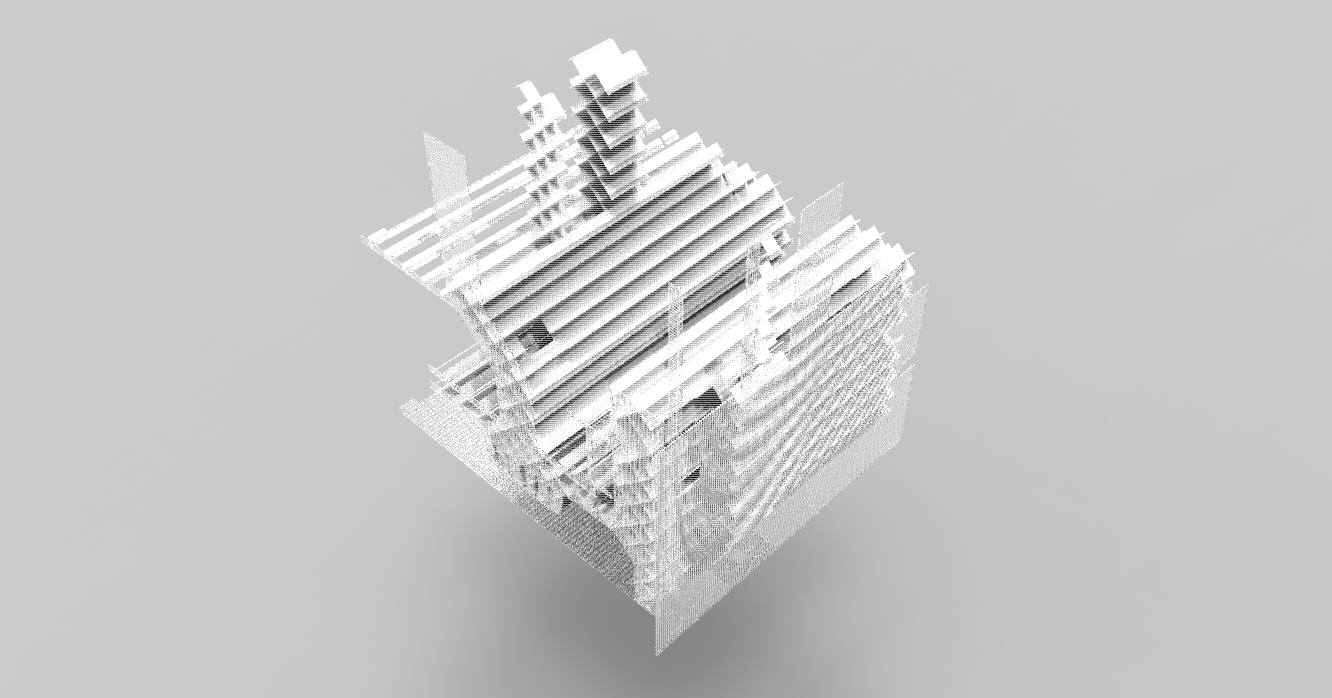
The final drawings and images displayed follow this logic,
using a process that we’ve termed the decollective, using a digital tear to
create a new object formed from the collective. (looking at the 3 images on
either side, they are composed of the initial data structure of the first
model, images of the 3d print and CNC, as well as the data structure of the
photogrammed model and the final render. The Exterior views, close ups and
sections argue this same point using this digital tear to display multiple
objects from the collective. Through all of this we’ve created a procedural
post digital scenario. The final images are all different variations of the
collective becoming objects themselves. They assert no sense of origin,
context, or orientation. The CNC model displayed attempts to argue this point
as it populated with figures varying in
scale moving unrestricted by gravity or other physical forces.