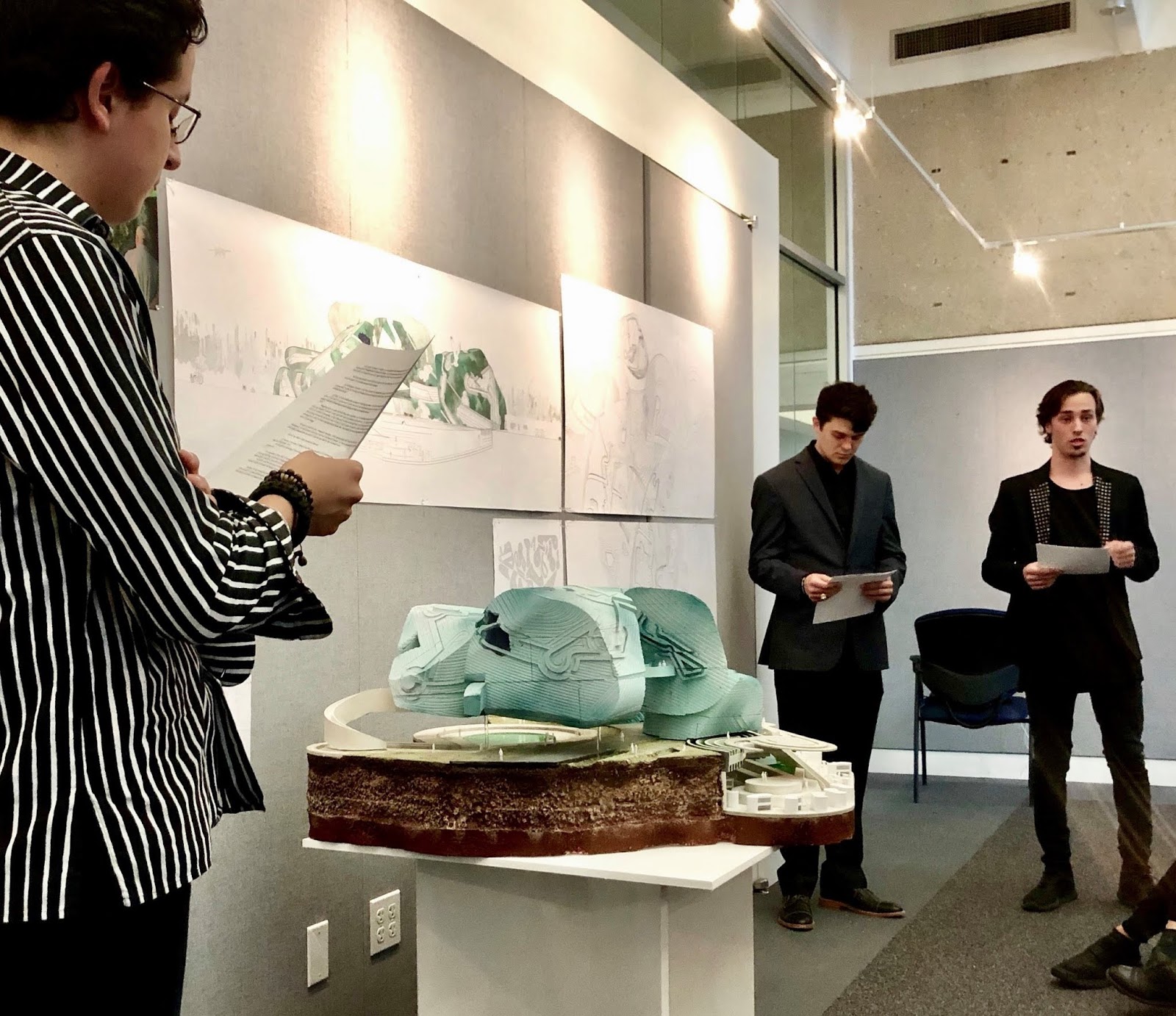
Jury Members: With Nate Hume. Michael Young, Kivi Sotamaa, Kristy Bailliet, Courtney Coffman.
Monday, August 6, 2018
Monday, May 28, 2018
T4T LAB Spring 2018 Stitching Immanence
T4T LAB Spring 2018. Rough and Saturated
Invited Professor: Nate Hume
Team: Paul Germaine McCoy, Grant Parker and Daniel Enyon
We think that reality and truth are
not separate, and while they are not the same, they engage selectively.
Our project operates, in reality, as
a research and development center for the Texas A&M Department of Wildlife
and Fisheries Sciences with a focus on algae biofuels and aquaponics. The
project started from the simple notion of the line as an object and evolved in
our process. When we projected these lines onto our ensemble, a series of
immanent figures created slippages between the ensemble and the site, resulting
in a difficult whole. Through a series of soap casts and color studies, the
project became saturated with a texture that referenced familiar notions of
material. Yet, while these things all serve to estrange canonical architectural
materials and forms, the truth of our project is that there still lies a deeper
issue of correlationism.
The distortion between reality and
truth is due to the innate perspective of the human. Thus, the state most
informed by the truth within this perspective is reality. As a result of the
distortion, we adopted the method of stitching things together to further
explore the issue of correlationism in a clear way. The stitch brings together
various views of the object to reconstruct a reality based on the epistemology
and ontology of the object. This reconstruction occurs in the manner that
knowledge of the real and the being of the truth are weighted equally. Weighing
these as equal and stitching them together shows the disparity between them
when considered on their own. To allow clarity in this stitching, the drawings,
and the model only give selective sets of information, furthering our argument
by letting the drawings and model act unknowable and false, yet be operatively
real and true. The clarity that occurs in this process lets all the information
be questioned in a detective like game, where the viewer, is given multiple
sets of information and has to sort through where they connect and then wrestle
with what is correct.
We put forward the notion that it doesn’t matter
so much in the traditional sense that the drawings are “correct” or consistent,
but rather that the most important discussion to have is of how we view things.
As a result, we have coined the term “immanent drawings”. These appropriate the
idea that there is manifested, yet unused.
T4T LAB Spring 2018 Interlock
T4T LAB Spring 2018. Rough and Saturated
Invited Professor: Nate Hume
Team: Madison Green, Finn Rattana, Ray Gonzalez, Lauren Miller
Our
project is an investigation into the use of interlock as an estrangement
technique, that when implemented across Ground, Material, Surface, Line, and
Volume, creates ambiguity from their overlap that seeks to operate outside
digital tropes, producing objects that confound the boundaries between these
conditions.
Interlock
is an operation that fuses objects together while creating an edge. It is a
characteristic inherent of objects created in the physical world, connecting
parts by gluing, welding, joining, sewing, riveting, among others depending on
the material in use, and is frequently moved to the background of our
consciousness. The building seeks to implement vaguely similar qualities of
interlock to inject a sense of familiarity, and misuse these qualities as
Surface, Material, Ground, Line, and Volume, extracting the functional
preconceptions of their traditional use from their now estranged figuration.
Interlock
operates as Volume via implied geometric articulations of separate parts.
Interlocked parts suggest an unfixed disposition, puzzle pieces that were
assembled, or perhaps are intending to move or shift. At times parts may match
seamlessly and at other moments are misfit, forced together against their
geometric will to create a difficult interlocked whole, and the scale and
inhabitability of these volumetric interlocks serve to further displace our
preconception of their traditional use.
The
Site specifically influences our conception of alignment and misalignment, with
vegetation jumping across roads and paths, or ignoring these boundaries
altogether, or embedding unnatural geometric figuration with the vegetation
itself.
Interlock
serves to diminish any hierarchy between Building and Ground, and creates
ambiguity in differentiating which of the two categories parts belong to.
Ground serves as a way of displacing inside and outside conditions across the
site by giving enhanced interior qualities to the non centralized points of the
complex and enhanced exterior qualities to the most central point of the
building’s mass. Ground and Site begin to operate as Volume, Surface, and Line
with the top layer of the land separating from it’s vertical edges, or becoming
tensile volumetric lines interacting with the building. These moments are expanded
upon with Material and Texture.
Texture
is derived from familiar architectural and geological sources and maintain
their traditional scale, but are subtly distorted to become unfamiliar via
Color and Materiality. The misalignment of textures to aforementioned
fluctuating typologies results in a hybridized materiality, relying on a
different system of interlock that is mildly aware of the system of geometric
interlock the project establishes volumetrically. At times Textures align to
these underlying moments, but also smear across the implied division of parts,
producing new conditions of discontinuous interlock that operate between
Volume, Surface, Line, and Material.
Hybridization
is critical to our interpretation of the project’s program as an addition to
the Crop and Soil Sciences Department in the College of Agriculture, to which
we have assigned a mixed use as Plant Hybridization Facility and Soil Analysis
Center. The Building and Site catalyze this program to produce strange
architectural qualities, specifically in the large plant volume in which
vegetation begins to behave as dynamic poche growing between the layers of the
double shelled metal mesh, in the seed vault with pods for containing each
generation of seeds the facility produces through experiments in selective
breeding and genetic manipulation, in the site’s pits that monumentally reveal
the underlying sediment of the site to visitors, and in the central soft serve
space which displays a gallery like array of soil samples currently contained
in the college.
These
moments disrupt the edges between the work produced in the Crop and Soil
Sciences Department and the access to that work, and reinforce the overlapping
hybridized interlock and material conditions produced by the project.
Thursday, May 24, 2018
T4T LAB Spring 2018 A Billboard
T4T LAB Spring 2018. Rough and Saturated
Invited Professor: Nate Hume
Team: Luis Fernando Munoz, Stephanie Maddamma, Sephora Belizor, Brazoz Pinto.
This project is an
exploration of graphics and their interpretations and possibilities. We define
“the graphic” as two-dimensional figures that overlay or project over objects.
The graphic is no longer a representational vehicle but is now used as a means
to unroll an object and connect or disband parts, constantly oscillating
between being fixed and becoming. We take the notion of the architectural
billboard and unroll it, using the graphics as a way to exploit the spatial
latency that lies within them.
The billboard has
historically acted in many different ways but mainly as 2-dimensional imagery
used to promote specific values of any given subject. It is as well a cultural
icon that yields attention yet denies interaction. However, in this project, the
billboard becomes an architectural object that develops into habitable graphic
space through giving volumetric qualities to 2-dimensional figures. The
binding of dissimilar yet congruent figures though the application of the
graphic projections, that at times unroll over the surfaces and generate
phenomenal objects, and at other moments transpose though dimensions to flatten
spaces. We move away from an application of a super graphic, and materials no
longer only slip from floor to wall to ceiling but they also cross boundaries
and thresholds beyond dimensions to create their own graphic space that
trespasses and unrolls the building, the objects, and spaces. This unrolling,
as opposed to an unfolding poses an object that is always in the state of
trying to know itself, in a point of self-reflectivity.
The project operates in
terms of Triple-O as outlined by Mark Foster Gage in his essay, Killing
Simplicity. Acting as objects themselves, the graphics exist within the
building in a three-dimensional state, allowing other objects to inhabit them.
These objects which are inhabiting graphic space are unaware of the qualities
of the graphics themselves, causing the building to never be fully knowable at
any point in time. Through the use of graphic as an object we question the
subject and destabilize their relationships. Objects inhabiting graphic
space are unaware of their placement within, however the graphic as an object
is aware of its placement and of that which inhabit it.
We further destabilize
the subject by denying a privilege to plan or section, as the architectural
billboard unrolls in many different orientations and does not solely revert to
one. The ability of 2-dimensional representation to imply a 3-dimensional
object contributes to the ungrounding of architecture by removing the privilege
of verticality and horizontality through section and plan opposing Colin Rowe’s
argument in Transparency, literal and phenomenal. In the essay, the
privileging of verticality and horizontality is argued by its necessity in
achieving phenomenal transparency since a subject must perceive a widely
accepted given reality that, through its ability to be recognized, allows a
subject to determine the ontological and orientational properties of that which
is unseen. In this project, the reality provided has orientational qualities
not widely accepted, causing a disconnection between object orientation and
ontology, enforcing object to object relationships. The interior and
exterior are no longer elements which allude to each other in their design, but
the material logic and surface phenomena of the exterior inserts itself within,
generating breakages, folds, and slippages that imply new phenomenal objects
within that diffuse boundaries of interior and exterior that exist in through
multiple dimensions.
We place implications on
reality and unground the monocular subject. This is not done by removing
gravity, instead it is done by the behavior of the surface and material logic
that does not respond to its intrinsic placement. Through this, the subject
becomes a meandering object. Subject/object relationships are developed as
object to object relationships. We now see the subject as a non-centralized
entity existing as human, object, or machine that occupies graphic space. Graphic
Space presents itself as a non-physical redefinition of interior and exterior
spatial conditions, using bleeding material to extend spaces past their
volumetric containers and scale down space within each volume. This overlapping
spatial condition then develops a new volumetric system that uses graphics as
means to bind or disband space.
The strange project
lends itself to cultural familiarity through its materiality, combining banal,
monochromatic material such as brick, concrete and scalloped shingles with
bright, saturated colors. With the multiplicity of material and spatial
conditions, the project finds itself as a graphic object, constantly
oscillating between 2, 2.5, and 3 dimensions. Working within the canons and
what is fixed in architecture. The billboard now gains volume and is inhabited.
Graphics become volumetric and no longer solely representational, and material
unrolls the Architectural billboard. It’s constant state of unrolling and
self-reflectivity decentralizes ontology and allows for the co-inhabitation of
graphic space.
Subscribe to:
Posts (Atom)