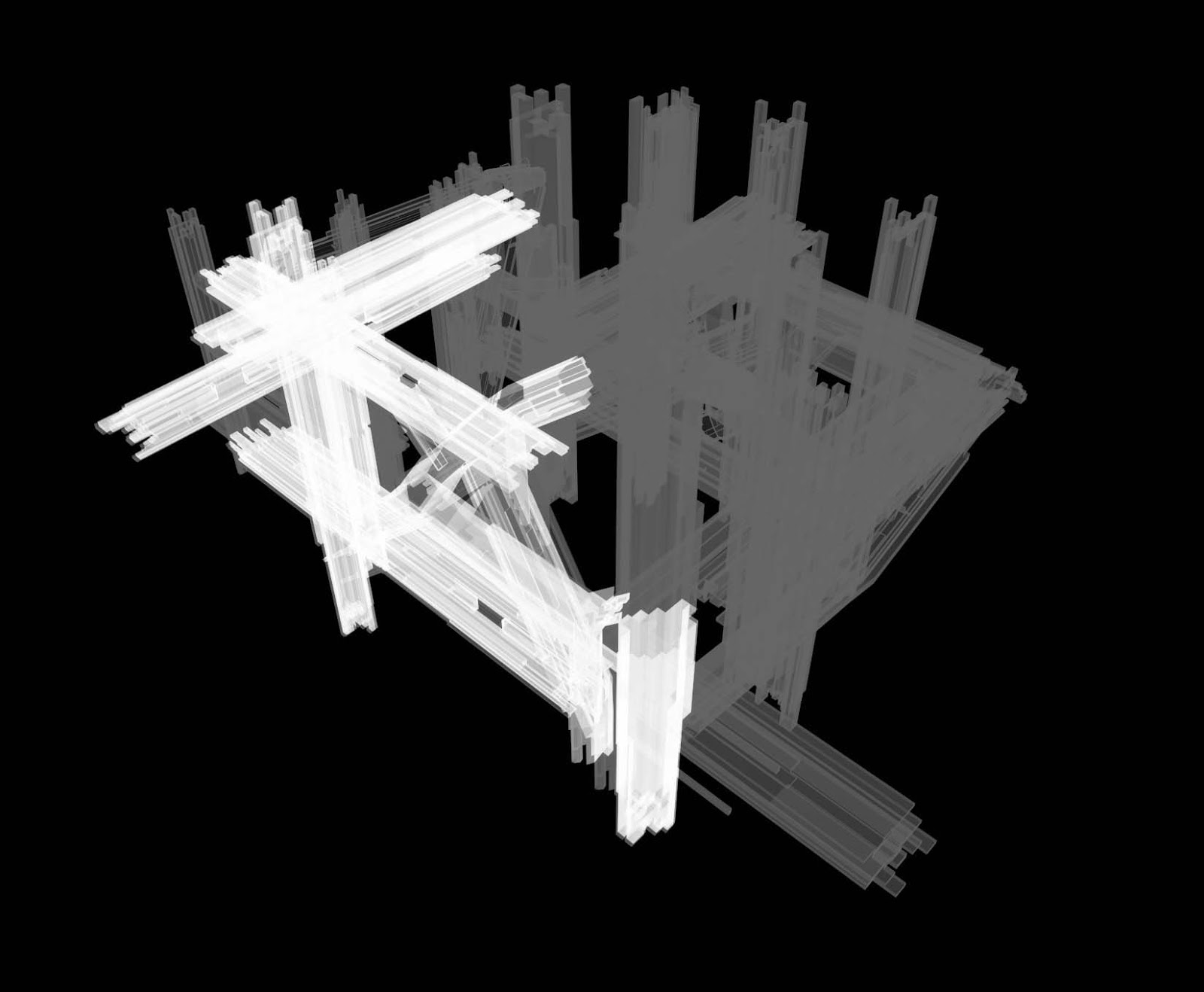
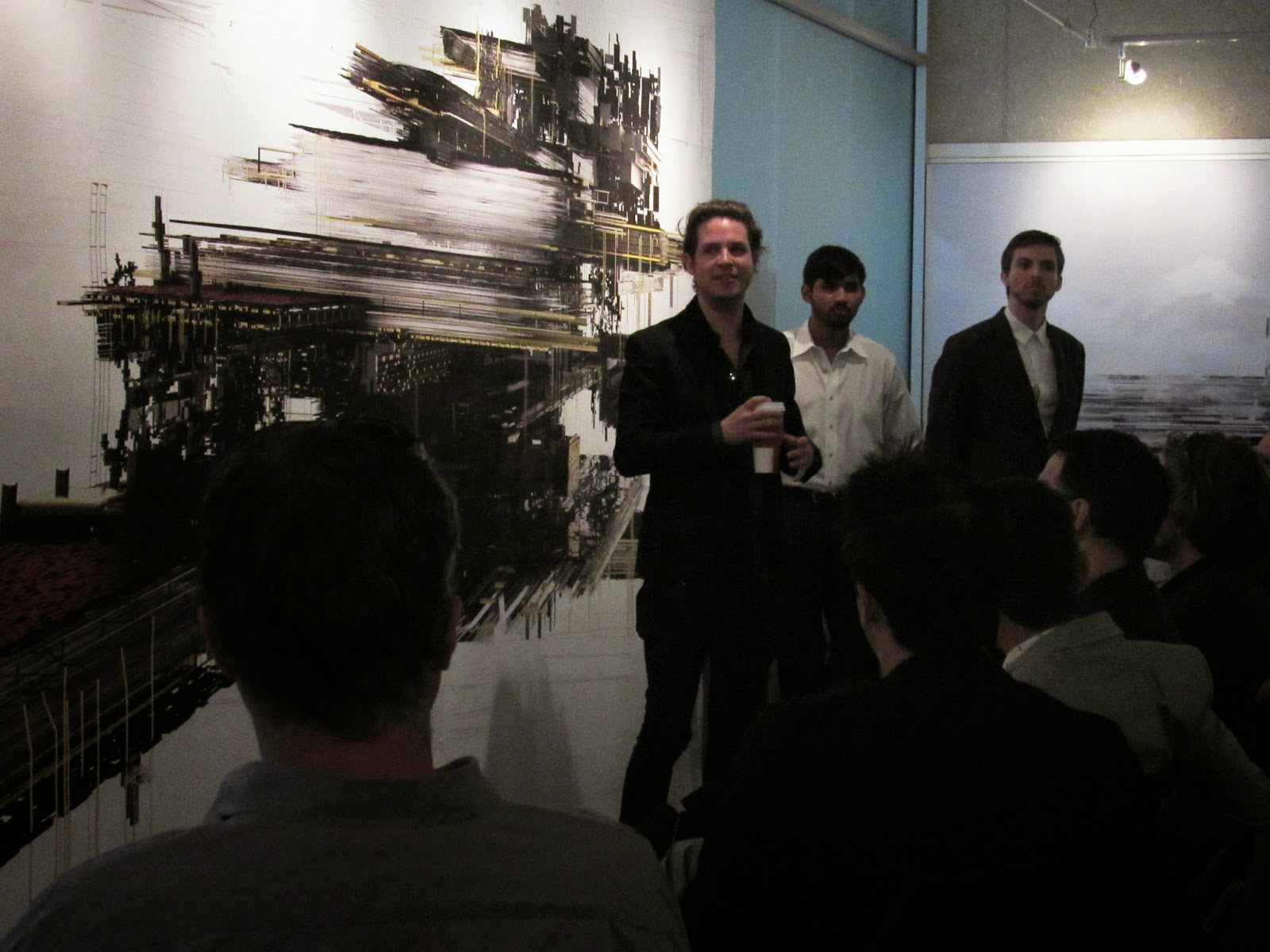
Texas A&M University. Department of Architecture. T4T LAB. 2015 "Alien, Messy Discrete"
Invited Professor:
Gilles Retsin.
with Gabriel Esquivel
Jury: Bruno Juricic, Levi Bryant, Adam Fure, Stephen Caffey, Rene Graham and Craig Babe.
01. Introduction : computing architectural
objects
Set within an Object-Oriented framework, this
studio investigates computational design strategies for an architecture of
increased heterogeneity. In contrast to holistic, organic and parametric
fields, the studio is interested in accelerated or high resolution forms of
bricolage and assemblage. Computationally, the focus is on developing design
methodologies which work with the fundamental constituent objects of
architecture - the bones – rather than the skin. Students will research
methodologies to organize and assemble large amounts of elements into
heterogeneous structures which respond to material, structural but also
aesthetic concerns. The lab takes a materialist, low-fi speculative approach,
which just slightly shifts reality. Computational design methodologies focus
on concepts like assemblage and discreteness, rather than organism and continuity.
These processes are set in a messy and discrete work flow, not as a single
meta-computational process, but more as a plethora of methods and objects.
Through establishing a rigorous connection between concepts of computation,
heterogeneity, objects and assemblage, the studio attempts to create a
framework for understanding the relation between computational design and
architecture.
The studio attempts to develop
non-metaphorical computational strategies, a design ontology proper for
architecture. Computational models are build up to organize and negotiate
fundamental architectural objects into new, strange mereologies – or sets of
part-to-whole relationships. The work resists a paradigm inspired by “nature” ,
which has been omnipresent within the discourse surrounding computation and
architecture. Instead of appropriating computational logics from nature into
architecture, we will try to develop a rule-set specific to architecture and
the material infrastructure it is based on today. Instead of computing and
generating predefined natural systems such as agent-based behavior, cellular
automata or L-systems, the studio is interested in computing architectural
objects.
02. Interregnum: the aggregatory
In recent years, architectural academia developed
a renewed attention for the object instead of the field. Inspired by
object-oriented ontology – architects started to question ideas of of
continuity, process, and nature which have been closely linked to the digital
paradigm in the past two decades.
Where computational research in architecture
initially started out with a deep interest for curvature, continuity and
gradual change, new research understands computation as fundamentally related
to the concept of the discrete and distinct. This shift from continuous field
to distinct object is profoundly linked with the nature of computation and
information, which can in the end be broken down to the calculation of a single
bit or unit. Computational processes like Finite Element analysis, cellular automata,
agent based systems and object-oriented programming languages are fundamentally
based on discrete units rather then continuous wholes. Object-Oriented
programming is a programming paradigm that translates concepts as objects or
classes which have specific methods to interact – the agency or behavior of a
class.
Levi Bryant describes his own philosophical
work, in particular the book “ The Democracy of Objects” , as a form of
bricolage. Indeed, the book is eclectic and heterogeneous, an assemblage of
Deleuze, Luhmann, Lacan and Harman. For Levi Bryant, bricolage loses the negative
connotation and becomes a rich concept. Bricolage is the attempt to forge
heterogeneous matter into a consistent object. From unrelated parts, a whole
object emerges. The bricoleur works with matter, with the material
infrastructure available.
In a non-bricolage process, there is a
predefined whole which is assembled out of perfectly fabricated, highly
customized parts. These customized parts would have no existence outside of the
whole – they are reducible to the whole. In bricolage however, as a strange
mereology, there is initially no whole – there are only parts. There is an
internal resistance and autonomy in the parts, a reluctance to be wholified
into an overarching object. This is were the material - realist grounding of
the bricoleur comes in. A bricoleur is fundamentally materialist, as he has to
somehow battle and negotiate with the material infrastructure of the parts he
wants to wrap into one object. Within a framework of strange mereology and
bricolage, computational power is not invested in the subdivision of an
object, but in a process of formation as a messy assemblage
of objects into an “emergent object”.
03. Ferment: mereology
Through a series of initial workshops,
students are asked to develop a computational design strategy, in which local
object-object interaction can create differentiation and establish bigger
objects as high-entropy, contingent multi-object objects without a need for
morphological coherence. Computed interactions between the agential objects
should result in a radically heterogeneous architecture with previously unseen
levels of information density. After a period of tooling-up where students
familiarize themselves with Processing, Rhino/Grasshopper and Zbrush , a
concrete design project rooted both as a computational and theoretical response
will be developed. The theoretical response aims to understand the nature of
the object within an assemblage and a framework of part-to-whole relationships.
Students are expected to produce an actual
readable architectural proposal for a small scale project, both through digital
computing and physical model building. Physical models can help developing
rules for the assemblage of material elements. The architectural proposals will
specifically develop knowledge and strategies about the interaction between
small scale elements and large-scale mass. The studio resists “mereological
nihilism” where an overall building model is developed and generated without
interaction with matter and material, and subsequently subdivided in
customized building components. Architectural projects emerge from a messy
feedback between high-resolution assemblage of discrete bits of material and
top-down design intend. Core-issues such as the relation between envelope and
structure, surface and mass, opaqueness vs transparency will develop as
examples of top-down decision making.
As a final output students are expected to
produce large-scale renderings and drawings, as well as a 1:33 scale physical
model.