Monday, May 5, 2014

From Language to Decimation. The Raw and The Synthetic


Texas A&M University. Department of Architecture. T4T LAB Spring 2014.
"Resistance of the Archetype"
Invited Professor: Bruno Juricic.

With Gabriel Esquivel.
Team: Corie Saxman, Christian Stiles, Kelli Lathrop.
Video Link:  
http://vimeo.com/m/92670009 


From Language to Decimation
Our object gives a glimpse into the inner most part of the digital object. It exposes spaces which are usually inaccessible to us. In turn this has exposed what could be considered as the “digital language”. In this sense the digital language could be described in two ways; the digital language in the sense of aesthetic characteristics, and the digital language in the sense of decimation. 
The object is essentially one language that has been decimated, introducing a variation of the same language. It began as a HI FI, High polly exterior, but through the decimation process the interior has transgressed into a LOW FI, low polly synthetic. They are now two objects, both digital, but in different stages. 
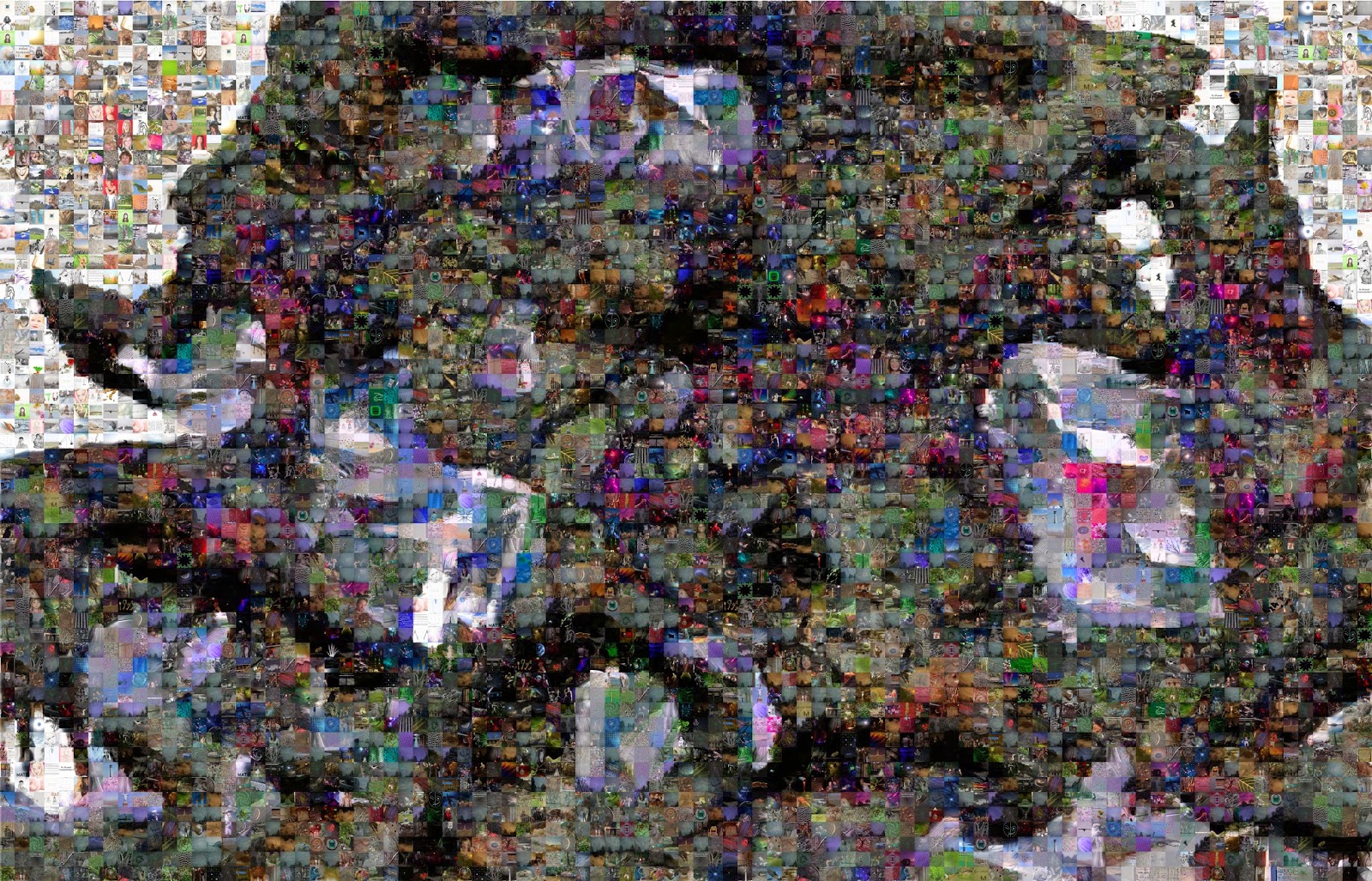
Through a series of explorations (i.e. the mosaic and unfolding processes) we have further reduced the digital language into dif­ferent conditions. We now have introduced the “big data” language, as well as decimated the object even further into its rawest form.

The Raw and Synthetic
The distinction of the interior and exterior in terms of the raw and the synthetic can be approached in two different ways. In terms of the geometry the interior would be considered the synthetic while the exterior would be the raw, given its topological nature. In terms of materiality the interior then becomes the raw due to its crystalline nature, while the exterior material exposes pixelation at a micro scale turning the exterior into the synthetic.

Interior and Exterior
The objects interior geometry is low polly and crisp. This type of geometry lends itself to further geometric studies; the simplicity of the forms can be algorithmically unfolded to further decimate the object into its rawest form. The exterior language is more complex, it’s messy, resistant and pixelated on a micro scale.

The object is essentially two objects that are interconnected, wrapping deep inside of each other. The interior spikes abide by a hierarchy of scale, growing larger the further they wrap into the interior. This in turn renders the spaces within the object inaccessible and uninhabitable.

The two languages of the object are connected, but constantly resisting each other. The distinction of the interior and exterior provokes a clash as well as a flirtation between two languages. The renderings show these distinctions through material, while the unfolding process shows this geometrically. However the section exposes these differences through materials as well as form.

The pixelation of the object is not only for aesthetic purposes, but it is a representation of the inner most language of the digital. It represents the decimation of the digital from the synthetic to a raw form.

Sunday, May 4, 2014

Resistance of the Archetype. The Raw and The Synthetic.


Texas A&M University. Department of Architecture. T4T LAB Spring 2014.
"Resistance of the Archetype"
Invited Professor: Bruno Juricic.

With Gabriel Esquivel.
Team:Lyly Huyen, Adrian Martinez, Stefani Johnson,
Video Link: 


Resistance of the Archetype

Our project explores the notion of ungrounding through a combining of the graphic realm with the scientific image. The graphic nature of our project investigates how application of generated patterns start to exacerbate the object as a way of testing limitations of the digital medium. Consequently, the object in question declares its autonomy by overcoming that which can be achieved through digital means. What is supposed to be an argument of Raw and Synthetic, becomes more of a conflict as the patterned synthetic is trapped in a state of tension with the raw object it is projected onto. This static moment captured in a continuous flux becomes the ultimate moment of ungrounding where Raw and Synthetic reach ultimate chaos and equal autonomy before either takes ­over.

The Raw, as stated before, is the object that is fluctuating between a hard and a decayed condition. The decayed, “soft” surface is created by external, unknown forces acting upon it by degrading the mesh. Its original, hardened condition is articulated by the stalactite-like surface found on the edges as well as underneath. It is called “original” because the hard surfaces are derived from the initial ground from which the object was excavated. Now floating and devoid of ground, the object is in constant search and yearning for another placement while simultaneously eating away at itself.   

The Synthetic is derived from generated patterns applied as a way of differentiating various surface typologies (hard + soft). Similar to the raw surface, the two patterns were created with both articulating different things: high-fi and low-fi. The high-fi pattern we determined was the sinuous graphic applied to the “simple” soft surface as a way of adding complexity. It starts interacting and becoming an active graphic dependent on saturation values with the white areas reverting the mesh to its concentrated original form. The low-fi pattern is a reticulation of the hi-fi pattern used to codify the hard mesh. This hyper-synthetic glitch graphic works dependent upon the angle at which you see it. From certain perspectives, the pattern’s geometric quality starts to simplify the mesh underneath, while at other times, you can see the textural quality of the mesh further pixelating the pattern at a micro-scale articulation.

The cartographic method fails when the patterns become so layered and complex that it ends up distorting the very surface it was supposed to define. Consequently, the object declares its autonomy since it is only perceptible because of the limitations of the medium. The pattern acts as a way of exacerbating the surface rather than blurring it. Similar to Alexander McQueen’s “Plato’s Atlantis”, the application or projection of the pattern onto a surface starts to distort depth perception and material reading and vice versa where the surface articulation starts distorting the graphic. Not only that, but the pattern adds another level of complexity that the raw fails to achieve. As discussed in Murakami’s concept of “Superflat”, the layering and scaling of certain portions of the pattern begin to allude to a two-dimensional depth that adds to the existing three-dimensional.

Video is used as a way of presenting a two-dimensional + three-dimensional representation of the object. Because of its graphic nature, the object in question is able to mix a comic book-like appearance with the scientific image. Through use of projection mapping techniques, we will be able to animate the 3D prints with the existing pattern as a way of showing that the raw object is in a continuous flux in its hard+soft raw form as well as its patterned, synthetic form (lifecycle condition).


[video]


Field Of Objects. The Raw and The Synthetic


Texas A&M University. Department of Architecture. T4T LAB Spring 2014.
"Field of Objects"
Invited Professor: Bruno Juricic.

With Gabriel Esquivel.
Team: Steven Hewett, Belinda Wood, Ricardo Gonzalez.


Field of Objects
This project has always developed around two ideas. The first being the epistemological approach to understanding objects and their qualities. The second being the reinterpretation of Giovanni Battista Piranesi’s Campo Marzio Dell’Antica Roma.
 We understand the raw characteristics of the objects in terms of the physical model. The geometry of the objects themselves is characterized as a raw quality of the objects. There is a very clear, one to one, understanding of the geometrical quality of the objects. We simultaneously understand the objects in terms of the renderings as synthetic. The low polygon geometry is still present within the objects, however the linework present begins to allude to qualities in excess of what these objects are. This much more complex understanding of the objects is what we define as the synthetic understanding.
The synthetic understanding of the objects can be divided into two distinct categories that we understand int terms of the character of the linework. There are Exhausted objects and there are Less Exhausted objects, and the objects level of Exhaustion has to do with ideas of turbulence. Deleuze de­scribes exhausted as being sort of strung out, so we understand the objects that are more exhausted to be more strung out, much much more turbulent. The less exhausted objects are much more resistive to the turbulence of the linework, and are therefore much less strung out. Within the less exhausted objects the geometric quality of the object is much more retained. The linework starts to react to edge conditions within the objects and produces a certain tension between the objects and their qualities.
The tension that exists between all of these qualities of the objects simultaneously; the Raw, the Synthetic, the Geometry, the Turbulence, and the Levels of Exhaustion, serve to transition the objects from mere objects to Objects of Interest.
Turbulence is a quality shared by both the low polygon objects and the ground objects. The turbulence found within the vortices of the ground object calls into question it’s solidity, it’s materiality and starts then to talk about motion, flow, and duration. Yet, the ground has clear boundaries. It is NOT boundless. These material, formal, and idealogical qualities then allow for the self declaration of the ground objects objecthood. It is also these qualties and the tension between the ground object and these qualities that again, translate the object into an Object of Interest.
Furthermore, it is the interaction between the objects of interest and the ground object of interest that begins the reinterpretation of Piranesi’s Campo Marzio. Piranesi was also interested in an epistemological understanding of architectural objects. This is evidenced in that he placed together in the Campo Marzio architectural objects from different time periods, different physical locations, and even purely fictional objects. It is clear that he had a very complex epistemological understanding of these objects, in order for him to develop such a complex understanding of their figure to figure relationships. It has been through our understanding of our objects epistemologically that has afforded us the same ability. The placement of the objects is in direct correlation to the ground objects turbulence. More turbulent objects exist within the turbulence. Now that the ground has declared it’s objecthood, the relationships are no longer merely figure to figure, but have transcended into figure to figure to hyper-figure.

Saturday, May 3, 2014

The Sensual and The Insensate. The Raw and The Synthetic


Texas A&M University. Department of Architecture. T4T LAB Spring 2014.
"The Sensual and The Insensate"
Invited Professor: Bruno Juricic.

With Gabriel Esquivel.
Team: Stephen Renard, Matt West, David Creamer and Hillary Hage.

Video Link. 

https://vimeo.com/92640873 


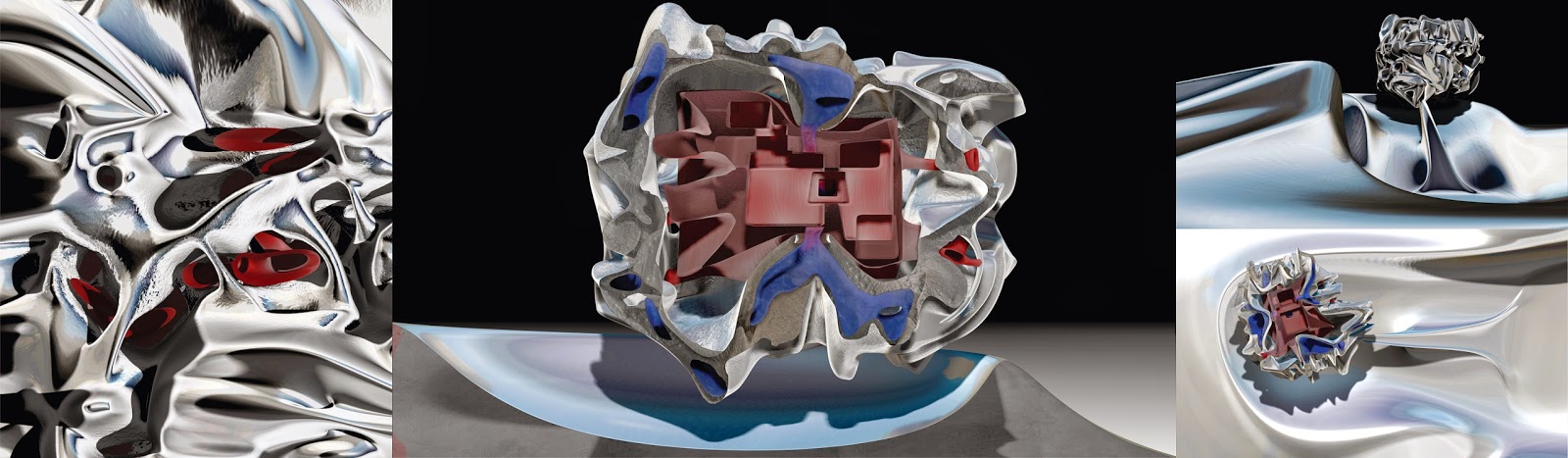
The Sensual & The Insensate          

The object within an object defines our project, proximity forcing two dichotomous forms to interact. This interaction illustrates a relationship between the sensual and the insensate, a futile relationship in which the objects will never coalesce nor achieve what they are wont to do. Our project discusses the conflicting objects and the consequences thereof, a conflict responsible for the formal relationships between the objects, as well as between the objects and the ground.
The exterior is dumb to external stimuli, insensate (bringing to mind Werner Herzog’s “Every man for himself and God against all” in which Kaspar Hauser cannot communicate his internal disfigurement, so the external object cannot communicate the presence of the interior); this object is synthetic; following no set pattern, constraint or delivery. Its form and material give a fluid appearance and only the scarring in pockets of phenomenal depth confirms its solidity.
In "the Raw and the Cooked" Levi Staruss writes: “We know [the] raw only because we know what [the] cooked is.”  This produces the idea of the implicitly raw interior, which manifests itself as the boudoir. This object pushes hollow tendrils through the insensate exterior, hoping to be seen, but still not accessed, implying the object’s possession of agency as well as a sensual nature. The interior is articulated to the point of interior design. As it is created by a cluster of cubes it questions scale and accessibility similar to Eisenman’s Cannaregio. It is the sensual, sentient object; it pushes through and against the exterior hoping not only to be seen, but to make the exterior feel it. This strife is responsible for the hollow spillage of the boudoir to the outside, the subterranean pockets (which are the only means of access to the boudoir), and possibly the form of the exterior itself (the forms of the exterior being caused by actions of the interior would also affirm its insensateness)
The poche portrays the implied fluidity of the insensate object. The clarity shows the design within, and calls into question the solidity. The viscous gel like texture gives the idea of a liquid, yet the solid aspects of the gel verify the solidity of the insensate. The sensual object has a porous solid materiality, alluding to that objects agency, as its thicker, more solid nature affirms that its form is not caused by other objects but by conscious movements on its part.  
These two objects not only resist each other, but also resist the ground, a sentient agent, as the object hovers away from it and has no formal relationship with it, other than proximity. The ground reaches with the ramp to touch it, to view and even access the interior, it hearkens back to Michelangelo’s The Creation of Adam as the sentient reaching towards and implanting sentience within the insensate.