Thursday, May 14, 2020

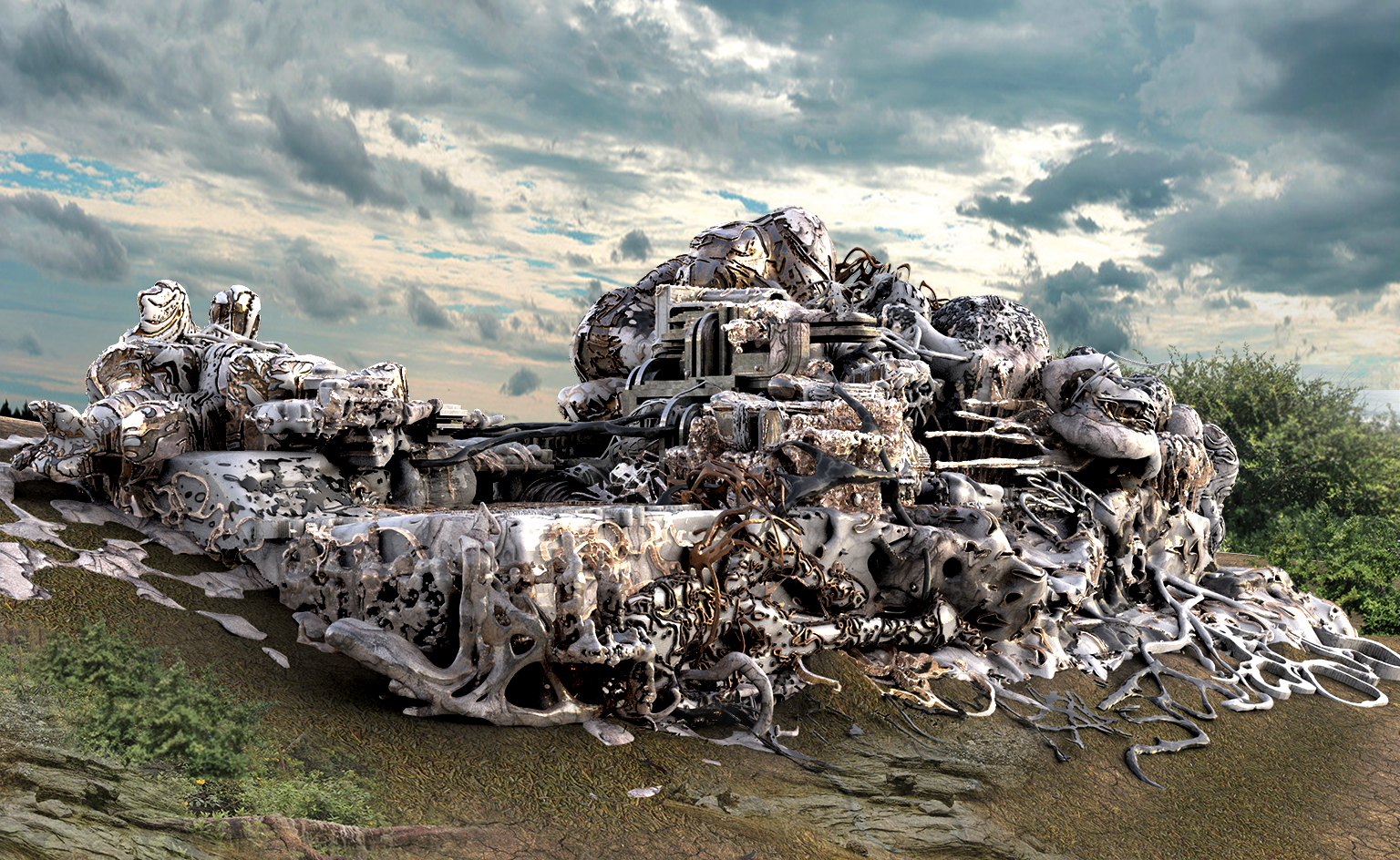
T4T LAB 2020 LACANIAN VILLA


T4T LAB Spring 2020
Invited Professor: Gonzalo Viallo from Morphtopia
Team: Finn Rattana, Manuel Alvarado and Joey Reich

As human actors, we lose ourselves to a cognitive condition related to the conscious awareness of ourselves. It is this obsession of ourselves as objects, and the condition of “I” or ego, that drives the speculation of this project. This condition also lends our engagement to qualities, rather than objects themselves, thus lending the project to the mediation of the Jective mereological system. In doing so, we utilize metaphor to speculate on the pursuit of unknown excess, in terms of the Other, and the trajectory of the Architectural Project beyond its manifestation alone. In these first images, we establish the project as an assemblage of parts with unfamiliar qualities, operating within the intrigue of unknown excess. Ultimately, this quality of the project begins to cross the lines of culture and nature, house and garden, and subject and object.

The studio began within the framework of pursuing the space of abundance with regards to the relationship between the Architect and the Architectural Project. The way we pursued this idea was to dive into the concept of Jectivity and utilization of the process of Metaphor-Variation-Repetition as initial drivers for the studio. Our approach led to an ontological treatment of Metaphors as mediators within the manifestation of the project, which we redefine as the Jective-Metaphor, which allowed us to liberate the Project from the limitations of subjectivity and objectivity through the connection of these legible qualities. In doing so, we were able to establish the trajectory of the project and the metaphorical vehicles through which the metaphorical vehicles we pursued the unknown qualities of the space of abundance.

In practice, the project began as a pursuit of the unknown via our selected images and subsequent representations. In each of these explorations we were able to refine tendencies that essentially became the first layer of references within the project. From these tendencies, we were able to align the Maison Bordeaux and selection of bugs in a way that created the condition of host capable of embodying desire and a condition of growth capable of delaminating, enveloping, and transplanting that host in a way that created lost familiarity.

Through this lost familiarity, we re-engaged the pursuit of unknown excess, which is understood explicitly as the gap between cognitive capacity of the subject and the perceived object. It was this relationship to cognition and subject that led to significant research into ideas of otherness with regards to its relationship to the space of abundance. In this pursuit, the metaphor of the Lacanian Mirror Diagrams emerged as a means of driving the project within the Jective system, which was focused mainly on the reality of the Other to remain just outside of reach, despite attaining everything up to and around that unknown quality of excess. In doing so, it became clear that within this diagram, consciousness lends itself to issues regarding identification of representational qualities as object qualities, thus establishing the problem of representation within the project.

In doing so, we were able to speculate on project of the built Bordeaux House as an indexical analysis done with the aims to unify the ideals of the Miesian space with Corbusien principles. Ultimately, these attempts to unify ideals will ultimately never be attained within this metaphorical construct, as is the limitations of the subject within this speculative framework. To move beyond representational analysis, we recognized the persistency of the Diagram as an architectural tool as it relates to identifying qualities between the thing itself and its sensations. In doing so, we established a pursuit of new diagrams as tools for discovering these in-between conditions. Ultimately, this provided the proceeding referential layer of diagrams of the insects, house, and context.

This diagrammed otherness allowed an understanding of the components through their perceived alignments, generating a series of chunks and insects most productive to the importance of these diagram. These chunks were then augmented in a way that refers back to the sensibilities from the project origins and combined these concepts in a series of iterations centered on the excess qualities of the project. In this pursuit, it should also be acknowledged that each of these assemblies are equally valid within the framework, but as cultural mediators we implemented a curatorial process of further references that resulted in the final arrangement and its proceeding developments.

To progress beyond this point, we placed ourselves within the repetition stage of Jectivity and once more entered into the Lacanian metaphor that cyclically drives this project. In doing so, we were now able to move the shift the house to the role of subject, projecting through the added reference of the Levi Bryan diagram, to produce a condition where the house is able transition to an ontological status of viewing and, thus, break down the separation of marked space. In doing so, this metaphor allows a criticality to be pursued regarding the qualities of otherness in terms of speculation on what forms of otherness the object-subject is able to project to in its own pursuit of otherness. Therefore, a condition emerges where the input references of the project engage within a flat ontology of context. This allows the house to cross the bounds of culture and nature to free it of typological constraints, blur distinctions between house and garden, and move towards unknown excess.

Ultimately, the assemblage of these references and strategies culminates in the final state of the project, having fully displaced into the Lacanian diagrams as a means of driving the pursuit of unknown excess. In this way, we are able to dialogue not just the qualities of this manifestation, but through new diagrams we are able to discuss new ways of conceiving the real and sensual qualities of objects around us. Ultimately this speculates on the bounds of the diagrammatic tool to produce the manifestation of the excessive. In the way this Jective mereological system facilitated our production of heterogenic complexity, ambiguity of typology, blurring of culture and nature, and complex balance of presence and absence that creates the visual excess in the project.


Wednesday, May 13, 2020

T4T LAB 2020 ENIGMATIC EXCESSES


T4T Lab Spring 2020 
Invited Professor : Gonzalo Vaillo from Morphtopia.
.Students: Hate Gesing and John Scott

Our project examines the Ennis house by Frank Llyod Wright, through the mutual irritation of volume, surface and line in excess. Existing at the scale of a single family house, each of these explorations have been unfolded, reconfigured, and then refolded within this particular monadic manifestation of the house. Possible manifestations of the project are infinite. We began to look at Leibniz’s idea of the monad as a vehicle for incorporating external references and issues of precedent. He argues that the monad is “pregnant” with the future and “laden” with the past. This means that it must contain within itself all “virtualites”, “potentialities” and traces of properties it did exhibit in the past. By dissecting and reapplying the aspects of the house that we know, we attempt to uncover elements of the unknown “real” in addition to the “sensual”.

Our mereology contains pieces of the original house which are recognizable, pieces that are not recognizable, and seperate pieces which have been tied in due to the interaction of their characteristics. Furthermore, components of the precedent exist in a state of ruination, while other elements of the house have been reconfigured, defamiliarized and deformed. While there are three genres of space within our mereology, there are numerous recurrent logics which have been applied throughout . Many of these logics stem from early explorations of aesthetics.

To break down the different aspects of this assemblage, it is important to understand how the pieces were originally dissected. Located in the southern foothills of Griffith Park in Los Angeles, the Ennis house has strong connections to Mayan revivalism and the textile block. The scalar resolution of the house changes depending on your viewpoint. For example, the silhouette of the structure is seemingly a skyline in itself, resembling a temple complex. However, a phenomenological experience of the house reveals a complex interaction between the pattern of tiling, and the manifestation of spatial arrangement. These “fractal-esque” tiled blocks become columns, space, and then an overarching formal arrangement for the house. The aspect of a multi-scalar resolution will be maintained throughout our current interpretation. These ideas, in addition to elements from the initial experiments have been foundational in the project.

By looking at the floor plans of the house, we were able to determine regulating line-work and view it as a means of framing and binding the volumes together. Furthermore, line-work was extracted from the site conditions at various scales. Lineaments formed from highways, and figuration from winding neighborhood roads are drawn on from a place of immanence. This line-work exists in its own right as three-dimensionalized components of the house, as a basis for a textural pattern that distorts the surface, and as a method of binding volumes together.

As tools of understanding, the monad and metaphor of the rhizome are not mutually exclusive. Our project uses them as immanent processes that overturn the transcendental model of understanding. Within this metaphor one can begin to understand that there is no distinction between the individual and the collective. This applies not only to the physical manifestation of the project, but to the theoretical framework as well. There are connections which can be traced to the precedent, but also various associations which are not immediately visible. In essence, our project was not produced through either a top down, or bottom up understanding of the assemblage.

Distortion and defamiliarization of the surface is a recurring theme, as we explored the extent to which surface treatment and texturing can produce a visual gluttony that eventually becomes semi-indigestible. Kant states that “ aesthetic occurs as an excess that goes beyond strict instrumentality and generates a function that opens up a new space…” For example, a terrace gateway formed from linework of the city, becomes a further divider of space with the application of “melted” drips. Thus, this specific application creates a terrace space that operates in the sensual liminal space. While this project is at the scale of people, it is spatially non-anthropocentric. Not all the spaces are able to be inhabited by people. Components of the Ennis house such as a collonade or plinth become propelling ruins when textures derived from original column blocks are reapplied, disfiguring the surfaces. Self referential moments draw from both textural and deformative processes. In other instances, these textures have been extruded and transformed into novel configurations to the point of the precedent being unrecognizable.

Incorporating these objects allows us to look for the point where the aesthetic unit begins to interact with and become part of the “real”. Otherwise defined as the previously unknown qualities of the project that are not sensually understood. As the process ripens, irreversible bonds form within the project. The interweaving of scalar relationships fuse together to create a multiplicity of treatments that produce different phenomenological conditions. Volumes formed through binding line-work and irritation of the surface are seen in multiple scales. This results in a resolution of exuberance that can be seen at the level of the whole, individual rooms, and within smaller components such as the fireplace. This application is similar to the incorporation of the tile patterning within the original house codified in a multiplicity scales. While exhibiting a gluttonous amount of ornamentation, it doesn’t operate in the same manner as a Baroque space. These spaces are not only encrusted but revealed and transformed by the qualities of the surface. In other words, these surface treatments directly alter and disfigure the volume instead of creating a continuity of figure.

In section, one can see how surface texturing has directly affected the poche in addition to the deformations from “binding”. Moreso, these bondages create autonomous spatial conditions in themselves. Within the plan there is an ambiguity of scale in which one may question if this is a single family house or a complex woven together of smaller spaces. This is another example of the scalar games between the differentiated spaces due to the resolution of excess. Within the project, excess and surface treatment are not simply blanketed over a disfigured form, but rather, used to ensure that all components are rhizomatically connected. More than a still life, our mereology is a project of both being and becoming. All components cultivate relations and irritations at different points of contention scattered throughout.

Our assemblage deliberately explores ideas of excess in an attempt to reach the space of abundance and draw out aspects of the unknown. The multiplicity of interaction between the volumes, surfaces and lines creates a gluttonous amount of visual information that can’t be entirely digested. In addition to referential and recurrent use of precedent in the shifts back and forth between 2D and 3D linework, the gluttony and relationality between line and form delivers a surplus of information that one is not able to read all at once. Thus, returning much of the project back to the realm of the unknown. By looking into the scales of excess between line, volume and texture the project achieves formal exuberance. Thus achieving both the “sensual” and the “real” within the domain of cognition through an abundance not of space, but of information from visual stimuli.
in the same manner as a Baroque space. These spaces are not only encrusted but revealed and transformed by the qualities of the surface. In other words, these surface treatments directly alter and disfigure the volume instead of creating a continuity of figure.


In section, one can see how surface texturing has directly affected the poche in addition to the deformations from “binding”. Moreso, these bondages create autonomous spatial conditions in themselves. Within the plan there is an ambiguity of scale in which one may question if this is a single family house or a complex woven together of smaller spaces. This is another example of the scalar games between the differentiated spaces due to the resolution of excess. Within the project, excess and surface treatment are not simply blanketed over a disfigured form, but rather, used to ensure that all components are rhizomatically connected. More than a still life, our mereology is a project of both being and becoming. All components cultivate relations and irritations at different points of contention scattered throughout.


Thursday, May 7, 2020

T4T LAB 2020 Machine Tendencies


T4T LAB 2020 
Invited Professor: Gonzalo Vaillo
"The Unknown"
Team: Bernie Guerra, Emma Sumrow

The project formulates the 21st century autopoetic machine with a quality of assemblage as it pertains to the house, generated through a series of mereologies and tendencies, as one object in a defined closed system. This paradigm negotiates levels of scale, resolution and viewing in specific ways through applied logics that argue conditions of the object as it is perceived.

            These applied logics, or tendencies, are understood as the generative mechanism and thus may become manifested as objects acting upon the subject of the house within this flat ontology. Levels of resolution and the multiplicities of viewing impact how the pieces are assembled and understood. This ontology and the assembly of parts, as objects, with their own applications are what is acknowledged as the unknown house with a series of tendencies to create a machine. Therefore, these mereological chunks become vehicles of said tendencies. These possess their own fundamental logics that create notions such as blurring, binding, and figure that are intrinsically linked to objects, the way they are used, the situations in which they are used, and their utility as parts. Objects within this mereology have a wide range of phenomena that assemble to form what is known about the house. Each part possesses its own logic and thus the house may then have, as a whole, similar ideas of phenomena from an ontological perspective. These tendencies, as defined by Deleuze, cause it to move away from the grounded and predictable to the more speculative condition, creating an ontological problem.

Furthermore,objects and whether or not they are known or are currently just knowable rest in this house and its multiplicity of viewing as there is a negotiation of a shifting focus between the familiar and unfamiliar amidst the labyrinth. Defined moments are dependent upon the house’s manifestation as a metaphor. The house, with origins tied to the Villa Savoye, negotiates these relations through figural assemblage, blurring, binding, ungrounding, misinterpretations, and multiplicities of viewing; the Deleuzian tendencies therefore reject the canonical, yet their source is one of the most canonical houses of the 20th century. There is thus a movement away from the prescribed and notion of predictability by creating new perceptions of the tendencies that reframe the obvious. Therefore, there is a new understanding of the Villa’s element of the ramp as it re-manifests itself into the site condition, creating a new organization of the approach as being within the ramp itself. The character of the maze injects itself ontologically into the site and machine, thus manifesting its own additional tendencies within the defined system of logics. This labyrinth creates a new approach to the machine in the midst of a field of objects such that the levels of viewing oscillate from what can or cannot be seen as one moves along the paths and eventually up the ramp, into the house.

These create questions of recognition through dissipation, or movement from known to unknown, and surpasses a fundamental understanding of the house as a metaphor of the 21st century machine. The metaphor suggests the identity of the chunks and tendencies by identifying a sensation in the viewer’s mind of the connection of these driving agents to the new paradigm of the machine. The new paradigm is driven by the autopoetic qualities which establish this perceived connection that is now dynamic rather than static. There becomes a difference in the viewing of the objects’ interactions in comparison to how these interactions may be speculated upon. These tendencies become phenomena that are already the new house themselves, thus in a knowable state that is. The allure, or style, reveals their nature and is ignited by their tendencies. They use the assemblages, and the assemblages follow operations in order to result in the unknown house. The levels of familiarity of the two primary figures shift with the amounts of enclosure from the closed house to the semi-enclosed cage-like courtyard. Interior surface articulations and object impositions mandate what can be viewed at various levels, thus furthering the notion of the unfamiliar style and the labyrinth. Their applied tendencies and impositions enhance the multiplicities of viewing and blur the understanding of these object-to-object interactions and figure-to-figure relationality.

 Therefore, the device and its mechanisms inform a new paradigm of the metaphor of the 21st century machine as it relates to the reinterpretation of a multiplicity of relationships whose readings are guided by the tendencies to then possess its ontology. In this way, the metaphor and its qualities were assembled through this series of tendencies which define the closed system that makes up the new autopoetic house with its own readings and understandings that has never stopped changing. ns through figural assemblage, blurring, binding, ungrounding, misinterpretations, and multiplicities of viewing; the Deleuzian tendencies therefore reject the canonical, yet their source is one of the most canonical houses of the 20th century. There is thus a movement away from the prescribed and notion of predictability by creating new perceptions of the tendencies that reframe the obvious. Therefore, there is a new understanding of the Villa’s element of the ramp as it re-manifests itself into the site condition, creating a new organization of the approach as being within the ramp itself. The character of the maze injects itself ontologically into the site and machine, thus manifesting its own additional tendencies within the defined system of logics. This labyrinth creates a new approach to the machine in the midst of a field of objects such that the levels of viewing oscillate from what can or cannot be seen as one moves along the paths and eventually up the ramp, into the house.


These create questions of recognition through dissipation, or movement from known to unknown, and surpasses a fundamental understanding of the house as a metaphor of the 21st century machine. The metaphor suggests the identity of the chunks and tendencies by identifying a sensation in the viewer’s mind of the connection of these driving agents to the new paradigm of the machine. The new paradigm is driven by the autopoetic qualities which establish this perceived connection that is now dynamic rather than static. There becomes a difference in the viewing of the objects’ interactions in comparison to how these interactions may be speculated upon. These tendencies become phenomena that are already the new house themselves, thus in a knowable state that is. The allure, or style, reveals their nature and is ignited by their tendencies. They use the assemblages, and the assemblages follow operations in order to result in the unknown house. The levels of familiarity of the two primary figures shift with the amounts of enclosure from the closed house to the semi-enclosed cage-like courtyard. Interior surface articulations and object impositions mandate what can be viewed at various levels, thus furthering the notion of the unfamiliar style and the labyrinth. Their applied tendencies and impositions enhance the multiplicities of viewing and blur the understanding of these object-to-object interactions and figure-to-figure relationality. 

Therefore, the device and its mechanisms inform a new paradigm of the metaphor of the 21st century machine as it relates to the reinterpretation of a multiplicity of relationships whose readings are guided by the tendencies to then possess its ontology. In this way, the metaphor and its qualities were assembled through this series of tendencies which define the closed system that makes up the new autopoetic house with its own readings and understandings that has never stopped changing. ns through figural assemblage, blurring, binding, ungrounding, misinterpretations, and multiplicities of viewing; the Deleuzian tendencies therefore reject the canonical, yet their source is one of the most canonical houses of the 20th century. There is thus a movement away from the prescribed and notion of predictability by creating new perceptions of the tendencies that reframe the obvious. Therefore, there is a new understanding of the Villa’s element of the ramp as it re-manifests itself into the site condition, creating a new organization of the approach as being within the ramp itself. The character of the maze injects itself ontologically into the site and machine, thus manifesting its own additional tendencies within the defined system of logics. This labyrinth creates a new approach to the machine in the midst of a field of objects such that the levels of viewing oscillate from what can or cannot be seen as one moves along the paths and eventually up the ramp, into the house.These create questions of recognition through dissipation, or movement from known to unknown, and surpasses a fundamental understanding of the house as a metaphor of the 21st century machine. The metaphor suggests the identity of the chunks and tendencies by identifying a sensation in the viewer’s mind of the connection of these driving agents to the new paradigm of the machine. The new paradigm is driven by the autopoetic qualities which establish this perceived connection that is now dynamic rather than static. 

There becomes a difference in the viewing of the objects’ interactions in comparison to how these interactions may be speculated upon. These tendencies become phenomena that are already the new house themselves, thus in a knowable state that is. The allure, or style, reveals their nature and is ignited by their tendencies. They use the assemblages, and the assemblages follow operations in order to result in the unknown house. The levels of familiarity of the two primary figures shift with the amounts of enclosure from the closed house to the semi-enclosed cage-like courtyard. Interior surface articulations and object impositions mandate what can be viewed at various levels, thus furthering the notion of the unfamiliar style and the labyrinth. Their applied tendencies and impositions enhance the multiplicities of viewing and blur the understanding of these object-to-object interactions and figure-to-figure relationality.

Therefore, the device and its mechanisms inform a new paradigm of the metaphor of the 21st century machine as it relates to the reinterpretation of a multiplicity of relationships whose readings are guided by the tendencies to then possess its ontology. In this way, the metaphor and its qualities were assembled through this series of tendencies which define the closed system that makes up the new autopoetic house with its own readings and understandings that has never stopped changing.